Graduation project: HerEducation
How is educational equity for girls and women discussed worldwide, and what does the data say?
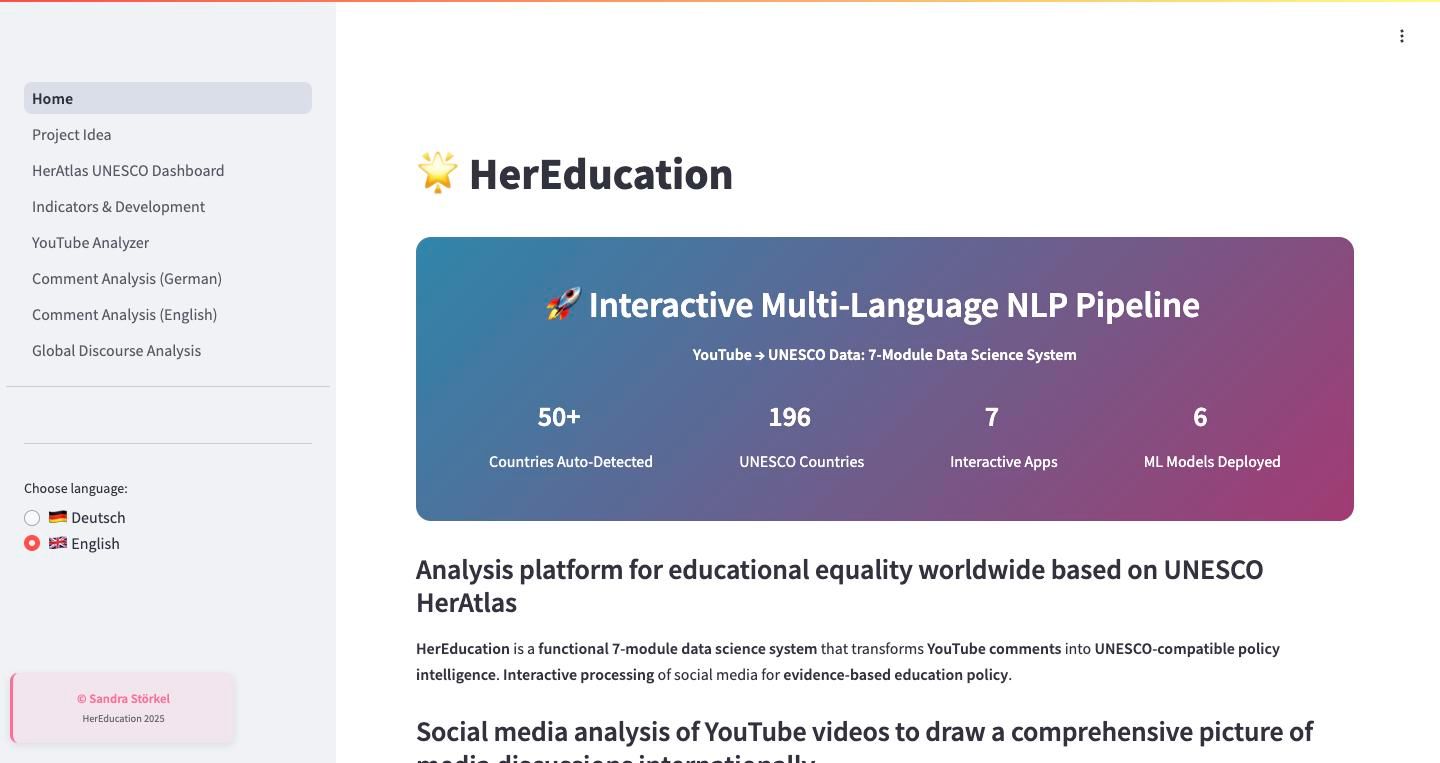
- 7-module platform: UNESCO education data for 196 countries, indicator development 2019–2025, YouTube analysis with Whisper transcription
- NLP pipeline for German and English YouTube comments: sentiment (BERT), emotion (RoBERTa), topics (BERTopic)
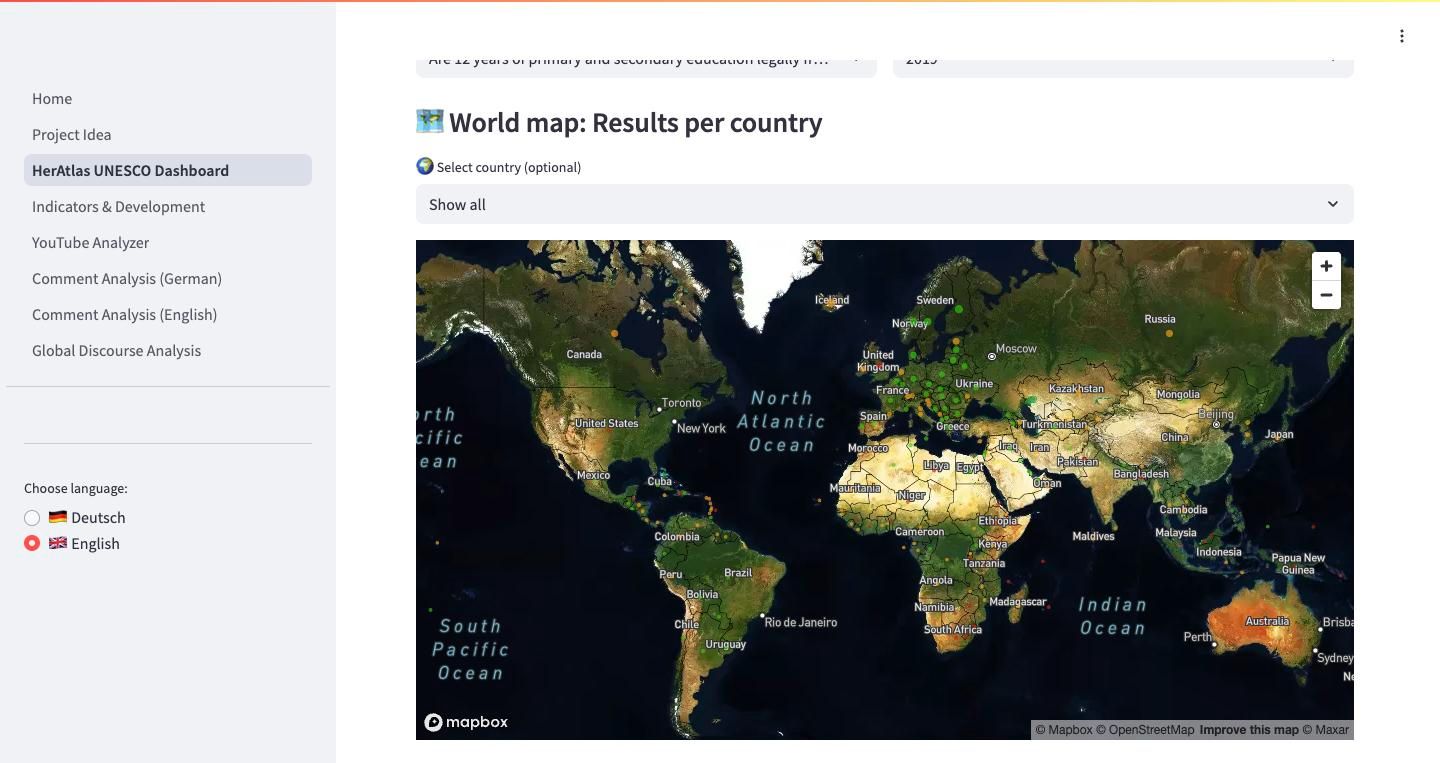
- Global discourse analysis: automatic detection of 50+ countries, world map, cross-country comparison
- Bilingual app (DE/EN)
- Python
- Streamlit
- Transformers
- BERTopic
- Plotly
- PyDeck
- yt-dlp
Screenshots
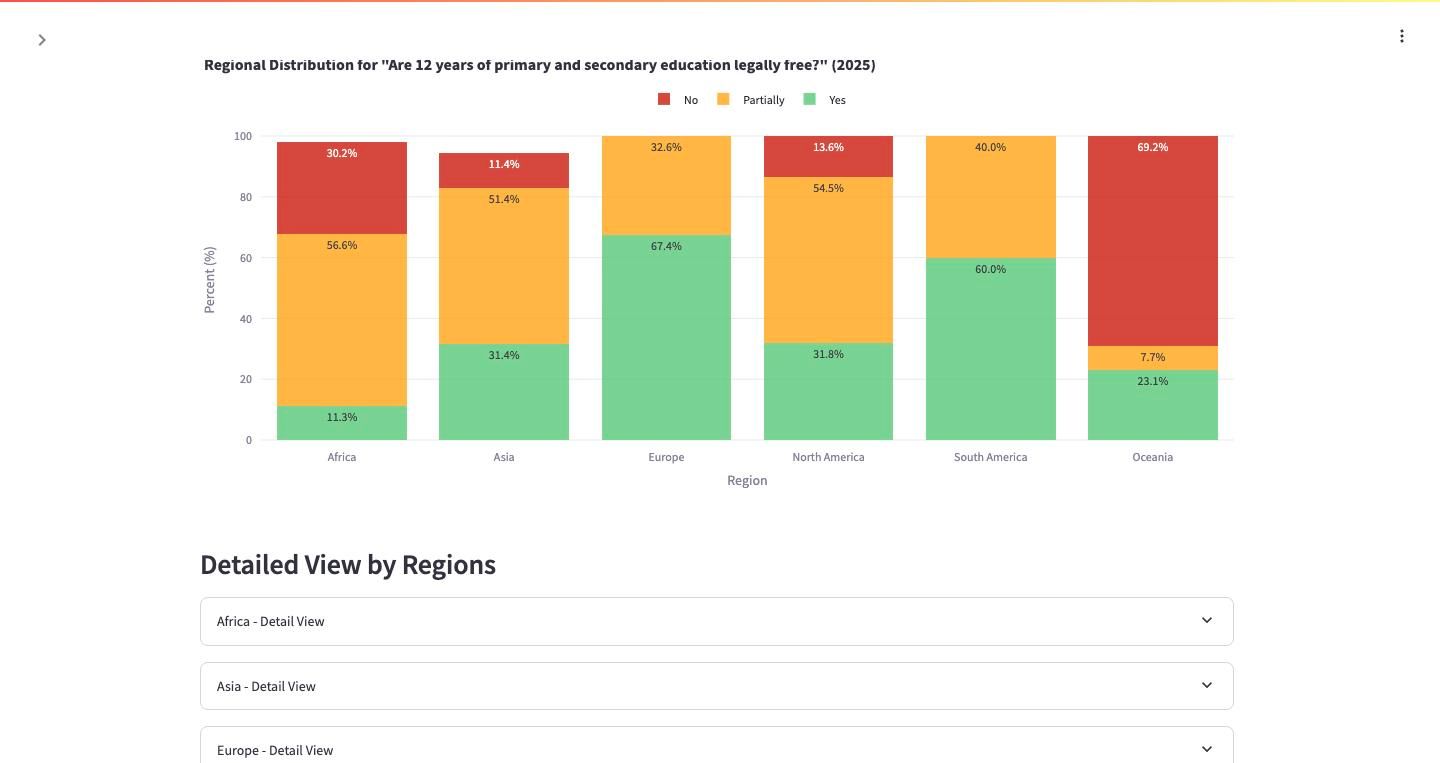
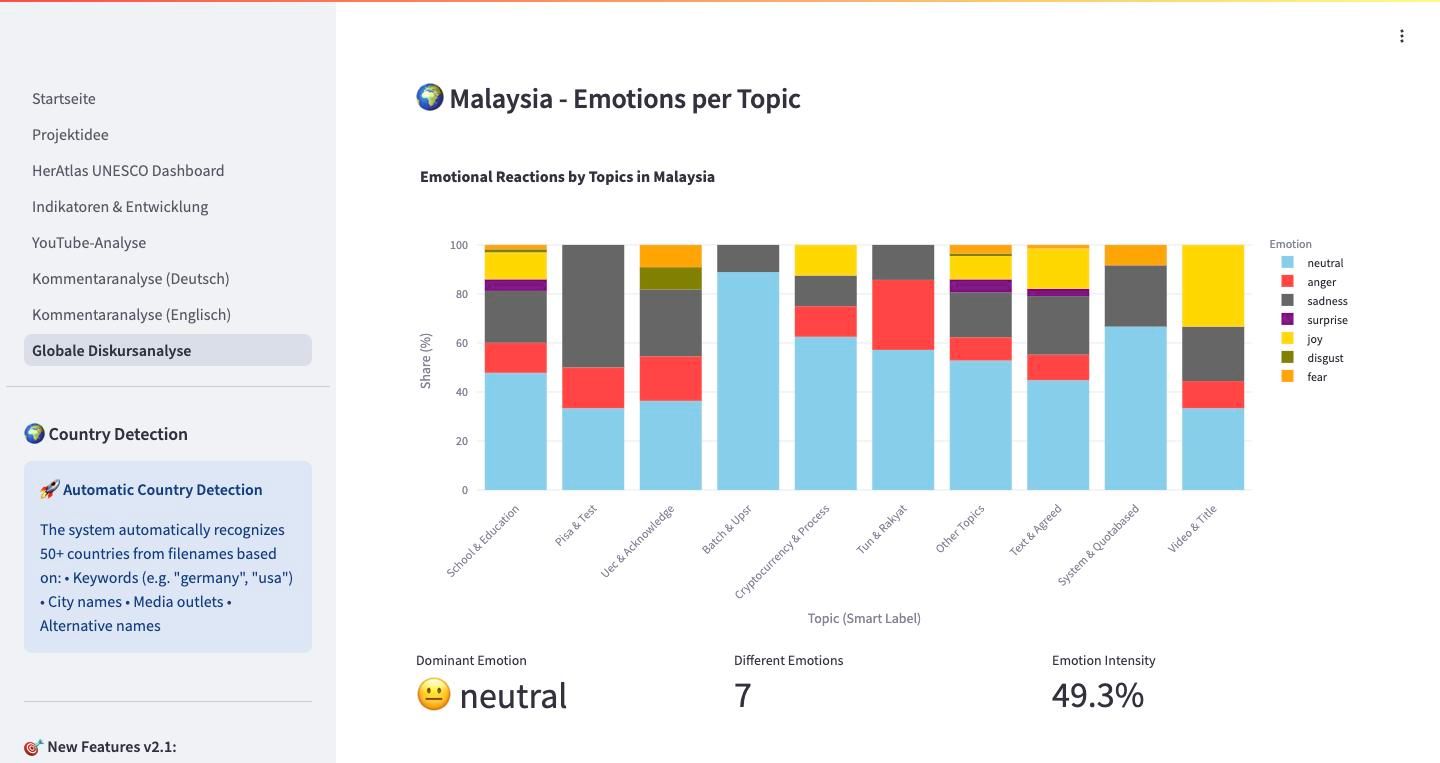
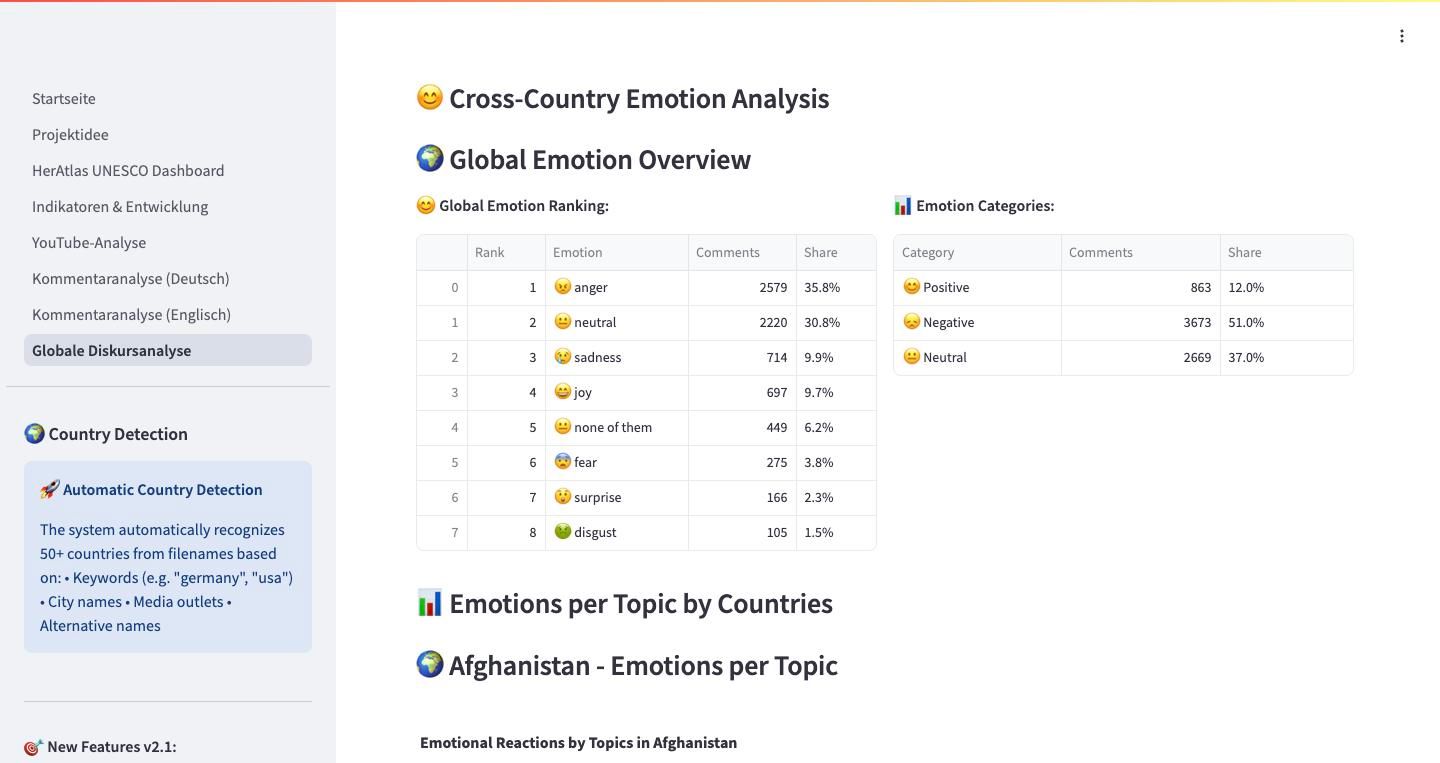
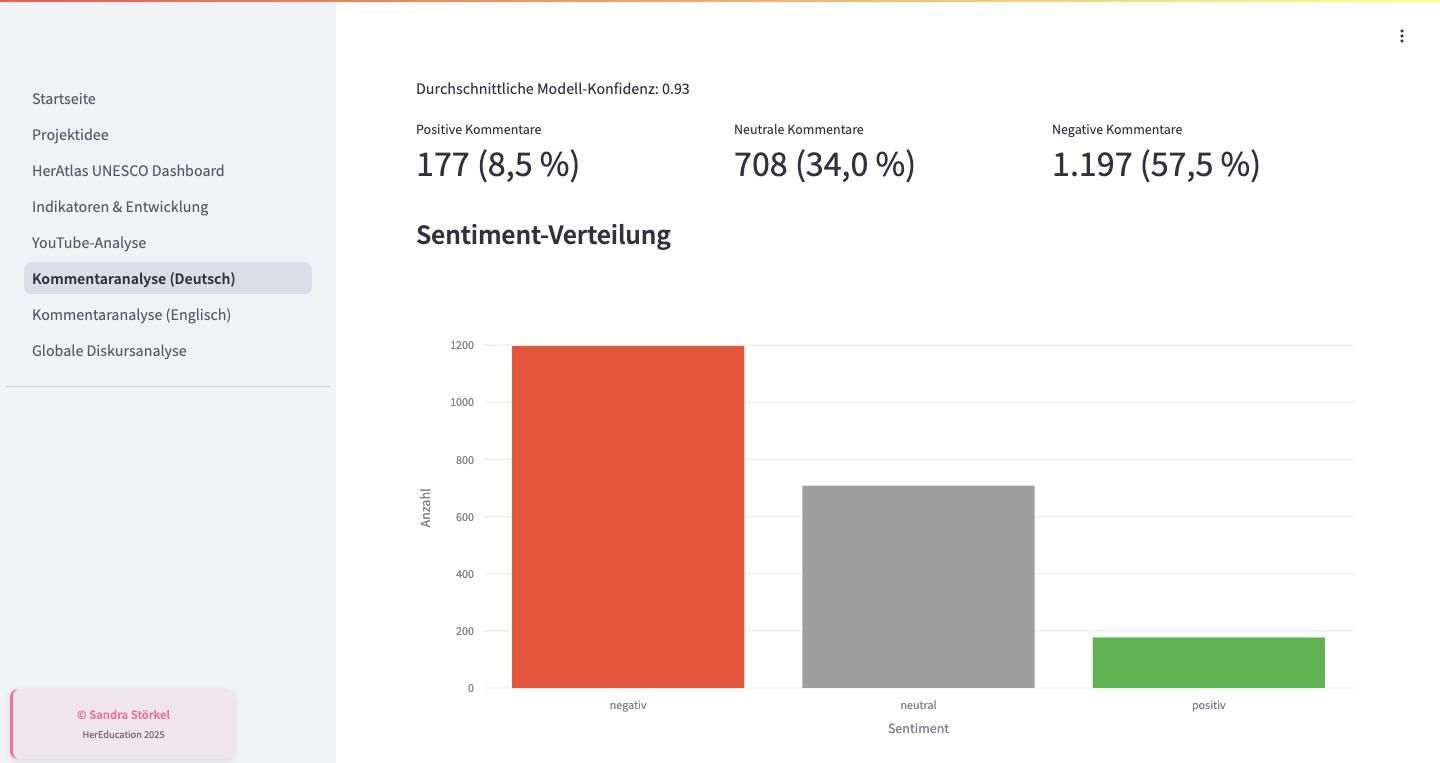
What do people think and feel about education?
Under YouTube videos about education, hundreds or thousands of people join the discussion. Nobody reads all of it. HerEducation's comment analysis does that work: it turns a crowded comment section into a clear picture of what people think and feel.
Questions it can answer
- What is the mood around a topic: supportive, neutral or critical?
- Which emotions sit behind it: joy, anger, fear, sadness, disgust?
- What are people actually talking about? It is often not what the video itself covers.
- Which emotions are tied to which topic?
- What do people say about a specific issue, such as gender equality, and how do they feel about it?
How the app works
- Sentiment: A language model reads every comment and rates it as positive, neutral or negative.
- Emotions: A second model detects the dominant emotion: anger, fear, disgust, sadness, joy or none (English comments also include surprise).
- Topics: A topic model finds out, without any preset list, what the comments are about and groups similar comments into topics.
- Emotions by topic: The app shows which emotions lie behind each topic.
- Focused search: The search uses ready-made keyword sets for education and gender (plus technology for English) or your own keywords. The app then shows only the matching comments, with their emotions, topics and examples. For gender, for instance, it looks for “women”, “girls”, “equality”, “gender” or “discrimination”.
Example: The ZDF talk show Markus Lanz discussed how AI is changing education (2024). Its 2,082 YouTube comments are 57.5% negative, 34% neutral and 8.5% positive.
From one video to a comparison across countries
The Global Discourse Analysis places analyses from several countries side by side. The app detects more than 50 countries automatically and shows the results on a world map. The theme search offers eight ready-made themes: education & learning, gender & equality, technology & AI, environment & climate, politics & society, economy & work, health & medicine, and culture & media. You can also enter your own keywords. For each theme you see sentiment and emotions by country and a ranking, and you can read the matching comments. This shows, for example, whether people in one country talk about equality differently than people in another.
Try it: Ready-made example analyses are visible right away. Below them, you can upload your own comment file (CSV or JSON). Online, the app analyses up to 100 comments per run, because the free hosting provider limits computing time. Installed locally, there is no such limit: on a MacBook Air (M4), all 2,082 comments on the Lanz video are analysed in about 1.5 minutes.
Live app
The live app runs on Streamlit Community Cloud and may take 1–3 minutes to wake up.